Player Instructions Handbook (Goalkeepers and Defenders)
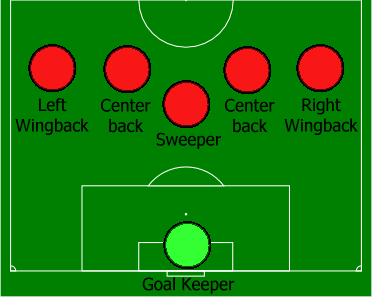
In most football management games, clicking a button like 'High Press' or 'Short Passing' just shifts a few hidden spreadsheet numbers in the background. In Footy Simulator, you are doing something much cooler—you are literally rewiring the physics of the pitch. Every single tactical instruction in this handbook directly manipulates the 2D velocity vectors and geometric passing lanes of players in real time.
Goalkeepers
The goalkeeper role, especially in the modern day, has seen a massive change. Goalkeepers have gone from being pure shot-stoppers to foundational playmakers. Goalkeepers are expected to act like outfielders and dictate the play and the tempo of the match. They initiate attacks, beat high presses through elite distribution, and operate as 'sweeper-keepers' to cover spaces behind high defensive lines.
Goalkeeper Distribution
- Short passes: Instead of launching a chaotic, 50-50 high ball down the pitch, the goalkeeper acts as the primary playmaker from the deep. This style is designed to invite the opponent’s forward lines to press high, deliberately pulling them out of position to create massive gaps in the midfield for your team to exploit once the first wave of pressure is broken.
- Balanced: A neutral, adaptive approach to building from the back. Instead of committing blindly to a single philosophy, the goalkeeper reads the layout of the pitch dynamically. If the opponent drops off into a defensive block, the keeper will calmly distribute short to the center-backs to control possession. However, if the opponent triggers an aggressive high press and suffocates the short option, the keeper launches a clearance into the midfield channels.
- Long passing: Instead of playing under pressure near your own net, the goalkeeper acts as a direct launchpad to start the attack. By clearing the ball deep into the opponent's half, the team completely bypasses the opponent's high-pressing forwards and midfielders. The objective is to pick out the target man or send a quick ball into the channels for fast wingers to chase down. While this eliminates the catastrophic risk of giving the ball away in your own box, it turns possession into a high-percentage 50/50 physical duel in the middle or final third of the pitch.
Goalkeeper Cross Behavior
- Stay near goal: With this instruction active, the goalkeeper prioritizes defending his goal rather than commanding the wider penalty area. When an opponent sends a cross into the box, the goalkeeper will take a conservative approach and stay in goal. This may be a safer choice for lower-level goalkeepers.
- Balanced: With this instruction active, the goalkeeper will have a well-rounded and versatile approach to claiming crosses. If the ball drops deep into the 6-yard box with minimal traffic, the keeper will aggressively claim or punch it away. However, if the ball is whipped toward the back post or drops into a dense crowd of bodies, the keeper will stand their ground.
- Come for crosses: With this instruction, the goalkeeper takes absolute priority in claiming crosses inside their 18-yard box. This relieves a massive amount of pressure from your defensive line and instantly kills off the opponent's attacking phase. However, it is a high-risk, high-reward strategy: if the goalkeeper fails to punch or claim the cross, they leave behind a completely vacant net for an easy opponent tap-in.
Center backs
In modern football, center backs act as the first line of attack and the anchors of the defensive unit. Evolving far beyond traditional 'stoppers,' they now operate as deep-lying playmakers who initiate build-up play, execute progressive passes, and handle high-pressing situations with composure.
Attacking Support
- Join the attack: This represents the modern tactical shift for a central defender. Instead of sitting back as the traditional sweeper role, the center-back actively steps forward to create numerical overloads during the possession phase in the second and final third. Depending on your team shape, they will either drive directly up the middle into the defensive midfield zone or perform late overlapping runs into wide channels from a back-three system. This instruction instantly unlocks midfields by offering an unexpected passing outlet, but it exposes you heavily. If your team misplaces a pass, a massive hole is created right in the heart of your defense, begging to be punished by counter-attacking teams.
- Stay back on defense: This is the traditional, zero-nonsense instruction for a central defender. While your midfielders and fullbacks push up the pitch to support the attack, the center-back refuses to leave their station. They remain deep, acting as a disciplined insurance policy and holding the structural shape of your defensive line. By staying home, they ensure your team is never left completely naked against a sudden counter-attack. They don't contribute to breaking down low blocks, but they excel at protecting your goalkeeper and managing the opposition's primary striker.
Full backs / Wing backs
The modern fullback (or wing-back) is no longer just a defender; they have evolved into primary playmakers, support midfielders, and tactical chess pieces. They are heavily relied upon to control the tempo of the game, provide width, overload central areas, kick-start attacking transitions from deep, and sometimes even have final third responsibilities.
Attacking Support
- Join the Attack: The modern, hyper-aggressive fullback/wingback instruction. The millisecond possession flips to your team, the fullback flies up the touchline like a winger. Their goal is stretching the opponent's defensive block horizontally and unlocking space for crosses into the penalty box.
- Balanced: A versatile, situational approach to fullback/wingback play. The fullback doesn't commit to running forward blindly, nor do they sit back on offense. If your wide winger drops deep to collect the ball, drawing a defender with them, the balanced fullback reads open space and makes an offensive run. If the space is congested, they stay back to offer a safe passing outlet.
- The classic, old-school fullback role. Even if your team is deep in the opponent's half, cycling possession around the box, this fullback refuses to advance on offense. They hold their ground alongside your center-backs, forming a permanent, protective wall. This instruction is designed to completely neutralize fast, tricky counter-attacking wingers who prey on empty flank space.
Run types
- Overlap: The classic flank-stretching behavior. When your wide winger or midfielder cuts inside with the ball, the fullback makes a run around the winger, hugging the touchline. This creates a numerical dilemma for the opposing fullback: do they follow your creative winger inside, or split off to track the overlapping runner? This is highly effective for breaking down compact blocks and creating crossing opportunities.
- An adaptive system where the fullback maps their trajectory based purely on the real-time coordinates of their winger. If the winger hugs the touchline to pin the opposing wingback, the fullback instantly identifies the empty space inside and executes an underlap run through the half-space channel. If the winger cuts inside to shoot or create, the fullback recognizes the open outer corridor and overlaps.
- Invert: Instead of running down the touchline, the fullback acts as a support midfielder when your team builds possession. They track diagonally inward into the half-spaces or sit right alongside your defensive midfielder, creating a solid 'double pivot'. This layout completely isolates your wide wingers 1v1 against opposing defenders while offering massive structural defense against central counter-attacks through the middle.
Support on crosses
- Hold position: A highly disciplined instruction for fullbacks: the fullback completely refuses to make a run into the box. If your cross fails, this fullback is already standing in the perfect structural layout to deny the opponent any clean wide outlets for a counter-attack.
- Stay on the edge of the box: A highly effective method for choking the opponent out of possession during sustained final-third pressure. Instead of entering the crowded penalty area, the far-side fullback pinches inside diagonally but stops right at the 18-yard box arc. They act as a physical blockade to recovery clearances, recycle possession back into the midfield, or unleash a shot against a retreating defensive line.
- Balanced: A fullback will alternate between making a run into the box and staying on the edge of the box, depending on certain conditions.
- Get into the box: When a cross is whipped in, a fullback activates an explosive diagonal run directly into the opponent’s penalty box. Because opposing center-backs are heavily preoccupied with your primary striker, a fullback arriving late is incredibly difficult for the opponents to mark, frequently resulting in completely free headers or tap-ins.